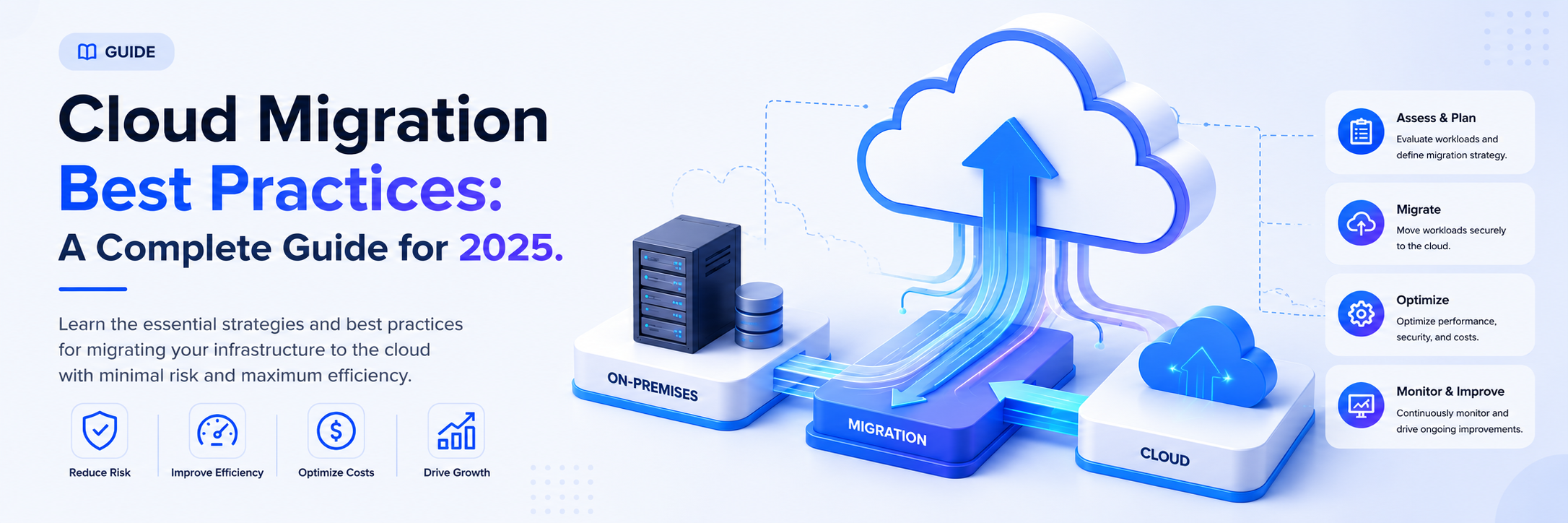
Learn the essential strategies and best practices for migrating your infrastructure to the cloud with minimal risk and maximum efficiency.
Introduction to Cloud Migration
Cloud migration has become a critical initiative for businesses seeking to improve scalability, reduce costs, and enhance operational efficiency. However, the journey to the cloud requires careful planning and execution to ensure success.
In today's digital landscape, organizations face increasing pressure to modernize their infrastructure. Legacy systems often struggle to keep pace with growing demands, and maintaining on-premises data centers has become prohibitively expensive for many companies.
The Compelling Benefits of Cloud Migration
Cost Efficiency
One of the most significant advantages of cloud migration is the potential for substantial cost savings. By moving to the cloud, organizations can:
- **Eliminate capital expenditure** on hardware and data center facilities
- **Reduce operational costs** associated with maintenance, power, and cooling
- **Pay only for resources used** through flexible consumption-based pricing models
- **Scale resources dynamically** without over-provisioning
Scalability and Flexibility
Cloud platforms provide unprecedented scalability that would be impossible or cost-prohibitive with traditional infrastructure:
- **Instant resource scaling** to handle traffic spikes or seasonal demands
- **Global distribution** of applications across multiple regions
- **Elastic infrastructure** that grows and shrinks with your needs
- **Faster time-to-market** for new products and features
Innovation Acceleration
Cloud providers continuously invest billions in cutting-edge technologies:
- Access to **AI and machine learning** services without massive upfront investment
- **Serverless computing** that lets developers focus on code, not infrastructure
- **Advanced analytics tools** for data-driven decision making
- **IoT platforms** for connected device ecosystems
Business Continuity and Disaster Recovery
Cloud infrastructure provides robust disaster recovery capabilities:
- **Automated backups** across geographically distributed data centers
- **Near-instant recovery** from failures or disasters
- **High availability** with 99.99% uptime SLAs
- **Built-in redundancy** at multiple levels
Understanding Your Migration Strategy
The 6 Rs of Cloud Migration
Every organization's migration journey is unique, but most follow one of six strategic approaches:
1. Rehost (Lift and Shift)
The simplest approach involves moving applications to the cloud with minimal changes. This strategy is ideal for:
- Quick migrations with tight deadlines
- Applications that work well as-is
- Organizations beginning their cloud journey
- Legacy systems that require minimal disruption
Benefits: Fast migration, minimal risk, immediate cloud benefits
Drawbacks: May not fully leverage cloud capabilities, potential for higher ongoing costs
2. Replatform (Lift, Tinker, and Shift)
Make minor optimizations to take advantage of cloud capabilities without redesigning the application:
- Migrating databases to managed services (e.g., Amazon RDS)
- Containerizing applications for better portability
- Implementing auto-scaling groups
- Optimizing storage solutions
Benefits: Better cloud optimization, improved performance, manageable complexity
Drawbacks: Requires more planning than pure rehosting
3. Repurchase (Drop and Shop)
Replace existing applications with cloud-native SaaS alternatives:
- Moving from on-premises CRM to Salesforce
- Replacing email servers with Microsoft 365
- Adopting cloud-based ERP systems
- Switching to managed collaboration tools
Benefits: Latest features, reduced maintenance, vendor support
Drawbacks: Data migration challenges, potential vendor lock-in, learning curve
4. Refactor/Re-architect
Redesign applications to be cloud-native, fully leveraging cloud capabilities:
- Breaking monoliths into microservices
- Implementing serverless architectures
- Adopting containerization with Kubernetes
- Building event-driven systems
Benefits: Maximum cloud optimization, best long-term value, highest scalability
Drawbacks: Most expensive and time-consuming, highest risk, requires specialized skills
5. Retire
Identify and decommission applications that are no longer needed:
- Redundant systems after consolidation
- Applications with low usage
- Outdated tools replaced by modern alternatives
Benefits: Reduced complexity, lower costs, simplified migration
Drawbacks: Requires careful analysis to avoid removing needed functionality
6. Retain (Revisit)
Keep certain applications on-premises, at least temporarily:
- Applications with regulatory restrictions
- Recently upgraded systems
- Applications without business case for migration
- Systems scheduled for replacement
Benefits: Focuses resources on high-value migrations
Drawbacks: Maintains hybrid complexity
Best Practices for Successful Migration
1. Start with Comprehensive Assessment
Before moving anything to the cloud, conduct a thorough inventory and assessment:
Application Portfolio Analysis:
- Document all applications, their dependencies, and integrations
- Identify data flows and communication patterns
- Assess technical debt and architectural issues
- Evaluate current performance baselines
Dependency Mapping:
- Create detailed dependency diagrams
- Identify tight coupling between applications
- Document external integrations and APIs
- Note licensing restrictions and constraints
Cost Analysis:
- Calculate total cost of ownership for current infrastructure
- Project cloud costs for different migration scenarios
- Consider hidden costs like training and tooling
- Factor in migration project costs
2. Build a Strong Business Case
Secure stakeholder buy-in by demonstrating clear value:
Financial Justification:
- Project 3-5 year TCO comparison
- Quantify expected cost savings
- Calculate ROI including soft benefits
- Model different scenarios and risks
Risk Assessment:
- Identify technical and business risks
- Develop mitigation strategies
- Plan for rollback scenarios
- Establish success criteria
Timeline and Resource Planning:
- Create realistic migration schedules
- Identify skill gaps and training needs
- Plan for business continuity during migration
- Set clear milestones and checkpoints
3. Choose the Right Cloud Provider
Selecting the appropriate cloud platform is crucial:
AWS (Amazon Web Services):
- Largest market share with most comprehensive service catalog
- Best for: Organizations needing cutting-edge services and global reach
- Strengths: Breadth of services, mature ecosystem, extensive documentation
Microsoft Azure:
- Strong integration with Microsoft ecosystem
- Best for: Enterprises heavily invested in Microsoft technologies
- Strengths: Hybrid cloud capabilities, Active Directory integration, enterprise focus
Google Cloud Platform:
- Leading in data analytics and machine learning
- Best for: Data-intensive applications and AI workloads
- Strengths: BigQuery, Kubernetes expertise, competitive pricing
Multi-Cloud Strategy:
Consider using multiple providers to:
- Avoid vendor lock-in
- Leverage best-of-breed services
- Improve redundancy and reliability
- Negotiate better pricing
4. Plan for Security from Day One
Security must be a primary consideration throughout migration:
Identity and Access Management:
- Implement strong authentication (MFA)
- Follow principle of least privilege
- Use role-based access control
- Audit access regularly
Data Protection:
- Encrypt data at rest and in transit
- Implement key management best practices
- Classify data based on sensitivity
- Comply with regulatory requirements (GDPR, HIPAA, etc.)
Network Security:
- Design proper network segmentation
- Implement security groups and firewalls
- Use VPNs for sensitive connections
- Enable logging and monitoring
Compliance and Governance:
- Understand shared responsibility model
- Implement compliance frameworks
- Regular security audits and assessments
- Incident response planning
5. Test Extensively Before Going Live
Never skip thorough testing:
Testing Phases:
- **Unit Testing:** Verify individual components work correctly
- **Integration Testing:** Ensure systems work together
- **Performance Testing:** Validate response times and throughput
- **Security Testing:** Identify vulnerabilities
- **User Acceptance Testing:** Confirm business requirements are met
- **Disaster Recovery Testing:** Verify backup and recovery procedures
Testing Environments:
- Maintain separate dev, staging, and production environments
- Mirror production configuration as closely as possible
- Use realistic data volumes for performance testing
- Automate testing where feasible
6. Train Your Team
Invest in building cloud expertise within your organization:
Technical Training:
- Cloud architecture and best practices
- Platform-specific certifications (AWS, Azure, GCP)
- Security and compliance in the cloud
- Cost optimization techniques
- Infrastructure as Code (Terraform, CloudFormation)
Cultural Change:
- Promote DevOps mindset and practices
- Encourage experimentation and learning
- Foster collaboration between teams
- Celebrate wins and learn from failures
Common Pitfalls to Avoid
Underestimating Complexity
Many organizations assume cloud migration will be straightforward, only to discover hidden complexities:
- Unexpected dependencies between applications
- Data migration challenges
- Performance issues in the cloud environment
- Integration difficulties
Solution: Invest adequate time in planning and assessment. Start with pilot projects to learn before tackling critical systems.
Ignoring Costs
Cloud costs can spiral out of control without proper governance:
- Over-provisioning resources
- Forgotten development environments
- Inefficient architectures
- Lack of reserved instance planning
Solution: Implement FinOps practices, use cost monitoring tools, set budgets and alerts, and regularly review and optimize spending.
Neglecting Security
Security breaches can be catastrophic:
- Misconfigured storage buckets
- Weak access controls
- Unencrypted sensitive data
- Inadequate monitoring
Solution: Implement security best practices from the start, conduct regular audits, use automated security tools, and maintain compliance requirements.
Poor Planning
Rushing migration without adequate planning leads to failures:
- Inadequate testing
- Insufficient rollback plans
- Poor communication with stakeholders
- Unclear success criteria
Solution: Follow a structured migration methodology, maintain detailed documentation, communicate regularly, and establish clear governance.
Insufficient Change Management
Failing to prepare the organization for change:
- User resistance
- Inadequate training
- Poor communication
- Lack of executive sponsorship
Solution: Develop comprehensive change management plan, involve users early, provide adequate training, and maintain strong executive support.
Cloud Migration Methodologies
Phased Approach
Migrate in stages, learning from each phase:
1. Pilot Phase: Migrate non-critical applications to test processes
2. Foundation Phase: Build core infrastructure and establish patterns
3. Migration Phase: Move applications in planned waves
4. Optimization Phase: Refine and optimize cloud environment
Big Bang Approach
Migrate everything at once during a planned cutover:
- Suitable for smaller environments
- Requires extensive planning and testing
- Higher risk but faster completion
- Needs comprehensive rollback plan
Hybrid Approach
Maintain some systems on-premises while migrating others:
- Gradual transition to cloud
- Maintain business continuity
- Supports complex environments
- Requires hybrid connectivity solutions
Post-Migration Optimization
Migration isn't the end—it's the beginning:
Cost Optimization
- Right-size resources based on actual usage
- Implement auto-scaling
- Use reserved instances and savings plans
- Clean up unused resources regularly
Performance Tuning
- Optimize database queries and configurations
- Implement caching strategies
- Use content delivery networks (CDNs)
- Monitor and address bottlenecks
Security Hardening
- Implement least privilege access
- Enable comprehensive logging
- Regular security assessments
- Stay current with security patches
Continuous Improvement
- Regular architecture reviews
- Adopt new cloud services and features
- Automation and infrastructure as code
- Build cloud center of excellence
Conclusion
Cloud migration is a transformative journey that requires careful planning, execution, and ongoing optimization. By following these best practices and learning from common pitfalls, organizations can successfully migrate to the cloud and realize significant benefits in agility, cost-efficiency, and innovation.
Remember: cloud migration is not a destination but a continuous journey of improvement and optimization. Stay committed to learning, adapting, and evolving your cloud strategy as your business needs and cloud capabilities continue to advance.
The organizations that succeed in the cloud are those that embrace change, invest in their people, and maintain a relentless focus on delivering business value through technology.
Tags
Rakesh Sharma
Cloud Solutions Architect
An expert in cloud computing with years of experience helping businesses achieve their technology goals and digital transformation initiatives.